Draco’s note to Hermione
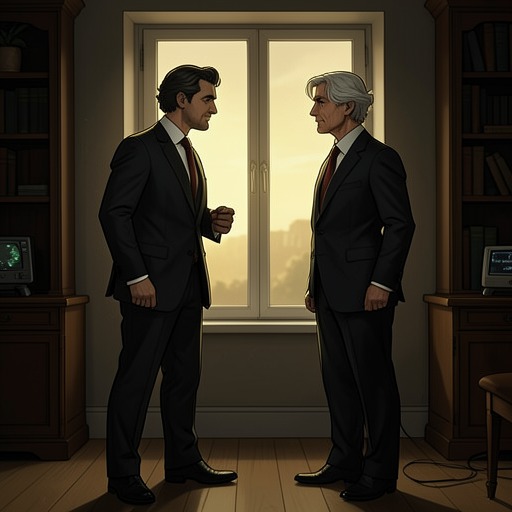
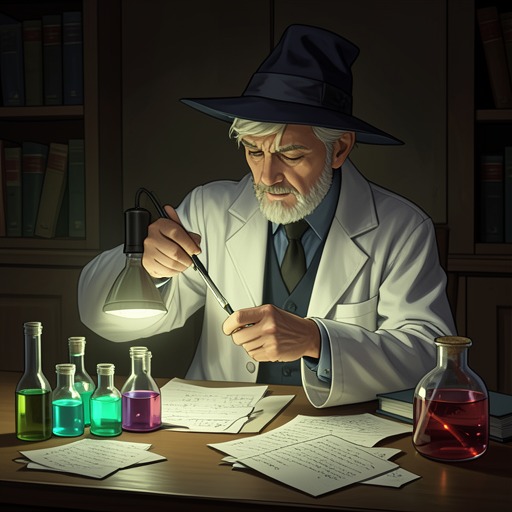
The Rules of WerewolfDraco’s note to Hermione is both a physical intrusion into Hermione Granger’s guarded professional world and a carefully constructed declaration of interest. Left on her office desk under the initials “H. G.”, it makes their flirtation portable, secretive, and dependent on interpretation. Its decisive function is not merely to identify a meeting place: by encoding the rooms of the Department of Mysteries, the note turns Hermione’s intelligence into the mechanism of their approach and gives their attraction the shape of a puzzle only the two of them can solve.
Appearance and Delivery
The note appears after Hermione enters her private office at the Ministry. She has already noticed the unusually persistent scent of parchment, spearmint, and an unidentified third element associated with the Amortentia in her office, but the envelope marked “H. G.” gives that atmosphere a concrete object. Hermione immediately questions how anyone entered her warded office and performs a diagnostic spell for dark magic before opening it. The spell finds nothing, allowing her to treat the envelope as an audacious personal message rather than a magical threat.
The neat handwriting and the absence of an identified sender make the object initially mysterious, but Hermione recognizes Draco Malfoy’s involvement as soon as she reads it. Her reaction moves from shock at his access and nerve to a slow smile, followed by the suspicion that he may delight and ruin her at once. The note therefore creates a double movement: it crosses a boundary around her workplace while also confirming that the boundary has been crossed with calculated care rather than indiscriminate force.
The Riddle’s Construction
The message is arranged as six short lines, followed by the initials “D. L. M.” Its wording links time, prophecy, death, space, and love: “It took Time to know I wouldn’t find you there”; “Thought I’d need a Prophecy to see”; “But Death would not separate you from me”; “I searched for you through the Space above”; and “And came to find you in Love.” The capitalized concepts are not decorative. Read together, they function as clues to the rooms of the Department of Mysteries, a fact later made explicit in the chapter’s explanatory note.
The riddle’s ingenuity depends on refusing a straightforward confession. Draco does not simply state that he wants to see Hermione. Instead, he makes the route to her into a sequence of abstractions, so that locating the destination requires the same kind of disciplined attention Hermione brings to research and magical bureaucracy. The note presents pursuit as both emotional and intellectual: Draco has searched for her, but he frames that search through the language of hidden chambers and conceptual thresholds.
Draco’s Motive and Self-Presentation
Draco Malfoy’s investment in the object is greater than his teasing manner suggests. He repeatedly looks back at the Witch Weekly issue containing their photographs, replaying the intensity of their eye contact and their encounter at the shoot. He has not heard from Hermione after leaving the note and doubts that she will answer, yet he considers the bribery used to gain access to her office worth every Galleon. He even regards that bribery as a comparatively minor corruption that he can repent for later, a thought that reveals both his entitlement and his awareness that the gesture is ethically questionable.
The note also records effort that Draco would rather disguise as wit. He searched Ministry records for Hermione’s employment history, relying on a favor from an Employment Resources officer whose debt arose after Draco dismissed a reckless traffic regulation that had attracted Muggle police attention. The message’s apparent spontaneity is therefore backed by research, access, and preparation. His attraction has made him resourceful, but it has also made him unusually exposed: he is besotted enough to engineer contact and insecure enough to expect rejection.
Hermione’s Reading and the Countermove
Hermione does not leave the note as a one-sided declaration. At the party at Nott Manor, she and Draco acknowledge that each has received the other’s message without immediately explaining either one. When Draco smugly observes that she has not mentioned his note, Hermione answers that he has not mentioned hers. Their exchange turns the paper into part of a reciprocal game rather than a message whose meaning Draco controls alone.
Her response is supported by her conduct. Attracted by the Manor’s library, she wanders through the stacks for more than fifteen minutes, loses the noise of the party, and opens an arched doorway while expecting the possibility of something concealed. The room contains nothing remarkable, and Draco’s sardonic laughter exposes the mismatch between her investigative anticipation and the mundane result. Yet the scene also externalizes the note’s method: Hermione is willing to follow a trail, test a threshold, and risk embarrassment in pursuit of an answer. Draco’s description of her as a book waiting to be devoured, offered by Theodore Nott in discussing the note, further binds her intellectual appetite to the erotic charge of the object.
From Coded Invitation to Relationship
The note’s immediate consequence is a private meeting that shifts the value of their connection from playful uncertainty toward acknowledged desire. Later, on a balcony at Nott Manor, Hermione confronts Draco with questions and identifies him before he announces himself. Their verbal sparring develops into explicit consent: Draco asks whether she wants him to touch her and insists that she state exactly what she wants; Hermione answers, “I want you to kiss me.” The note has thus done more than arrange proximity. It has established a mode of intimacy in which words, inference, challenge, and direct admission operate together.
That pattern continues beyond the Manor. Draco and Hermione later leave Hermione’s office hand in hand, with Hermione carrying the small green clutch Draco gave her, and Draco apparates them to Diagon Alley for the Longbottom birthday celebration. The note’s secretive first appearance contrasts with this visible movement together. What begins as an envelope hidden in a warded office becomes part of a relationship capable of crossing public and private spaces, while preserving the playful language of riddles that first allowed their attraction to emerge.